









 Twitter
 Facebook
 LinkedIn
 Flickr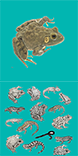
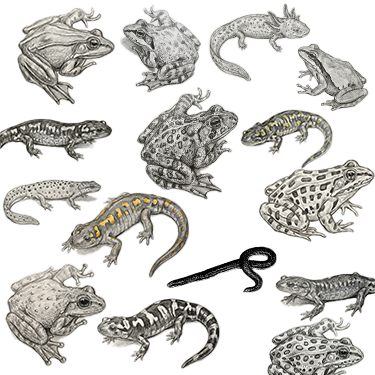
Amphibians evolved from fish in the water. Now they live all over the world. Amphibians are vertebrates, or animals with backbones. In fact, amphibians were the first animals with vertebrates on land. They were ancestors of birds, reptiles, and mammals. The three main types of amphibians are frogs and toads, salamanders, newts, and toads, and wormlike creatures called caecilians. Some amphibians live on land. Others live only in the water. But most amphibians spend some time on land and some on water. Amphibians breathe through their skin and through their gills if they have them. Their skin is wet and slimy. There are more than 4,000 species of amphibians on Earth. Let’s get to know amphibians!
Activity 1 – Living a Double Life
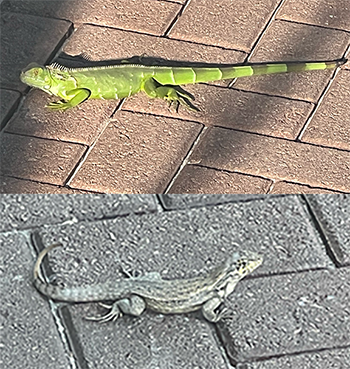
Amphibos is Greek and means ‘to live a double life’.
Amphibians live on land and in water.
Salamanders, toads, frogs, newts, and caecilians are all amphibians. They are cold-blooded and cannot regulate their temperature. They move around their environment to regulate their temperature to their desired temperature. Some sit in the sun, others move into and out of the shade.
Amphibians breathe through their skin, which is kept moist to absorb oxygen.
Activity 2 – Amphibians are Herps
Amphibians and reptiles are together called herpetofauna, or “herps” for short. All herps are “cold-blooded,” which means they lack an internal thermostat. They regulate body heat through interactions with the environment such as the warmth of the sun, the coolness of shade, or the moisture of being in the water.
Activity 3 – Lifecycle of Amphibians
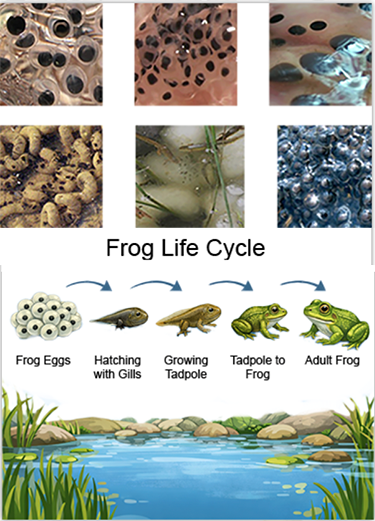
Most of the 4,000 species of amphibians lay eggs in water. The legs are covered in a goey slime. They lay many eggs at a time. Early life consists of living in water as a larva. Most amphibians grow into larvae in the first phase of life. Larvae begin with gills, breathing underwater like a fish. The larva stage can last from weeks to years, depending on the species. Frog and toad larvae are recognized as tadpoles as they swim and move around.
In the second phase, larvae develop into adults. Most amphibian species lose their gills and develop lungs for breathing, allowing them to live both on land and underwater. Different amphibian species change their structure in different ways. Some grow legs. Some lose their tail. The change from eggs to larvae to adults is known as metamorphosis. However, some amphibians are born as small adults.
Activity 4 – Why care about amphibians and reptiles?
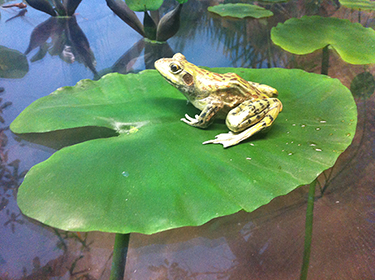
Amphibians play important roles in the ecosystems where they live. Some serve as predators that keep their prey’s numbers in check, like snakes that eat mice and other rodents. Other herps (or cold-blooded creatures) are the prey, like frogs, which serve as a food source for many species of birds, fish, mammals, and reptiles.
In addition, herps are valuable indicators of environmental health. Amphibians, in particular, are sensitive to pollution because their permeable skins easily absorb toxins. A diverse community of amphibians and reptiles indicates that the area is healthy and can support the plant and animal life that herps need for food and cover.
Activity 5 – Are amphibians and reptiles declining?
Sadly, the world’s amphibians are facing an unprecedented assault and are experiencing tens of thousands of years’ worth of extinctions in just a century. Scientists have observed these disturbing trends in the United States, where approximately 20 percent of amphibian species and 10 percent of reptile species are at risk of dying out. While habitat loss is the most obvious cause of endangerment, disease, UV radiation, road kill, and climate change contribute to their decline, along with over collection and unregulated hunting. What can we do to save amphibians?
Review
- Amphibians were some of the first animals with backbones to live on land.
- What does the word “amphibos” mean?
- Which of these animals is an amphibian?
- Amphibians are warm-blooded animals and control their body temperature.
- What are baby frogs called?
- Amphibians can help scientists know if the environment is healthy.
- Which of these is a reason amphibians are declining?
Explore
Relate







All contents copyright © NEXT.cc. All rights reserved. Terms of Use